Pages

Sunday, September 8, 2013

Omega Bars


Whenever I whip up a batch of energy bars, I tend to use the same ingredients... Lots of nuts and seeds (or nut and seed butters), something sweet like dates or raw honey, raw cacao nibs, superfoods like spirulina, goji berries or maca and shredded coconut or coconut oil. 
Energy bars are something that should deliver what the name implies: ENERGY!  Unfortunately a lot of so called energy bars in grocery stores are filled with lots of sugar and unrecognizable ingredients. I used to rely on these bars a lot in college or as a pre- workout snack, but they didn't really give me anymore of a boost that a handful of nuts and a piece of fruit.

These here bars are chocked full of all sorts of goodies that are high in protein (walnuts, hemp, flax and chia seeds, pumpkin seeds) antioxidants (raw cacao) natural sugars (dates and raisins), and healthy fats (coconut oil). A couple of these washed down with a cup of coffee in the morning will give you a serious boost, no doubt.

You're probably wondering about the name: Omega Bars.

O.K. Let's talk about it....

Three Words:

Essential. Fatty. Acids.

You've no doubt heard the term thrown around these days.. Maybe Omega 3 fatty acids rings a bell?

Omega 3 fatty acids are considered essential fatty acids because they are necessary for human health. But.....your body is incapable of producing them on their own, so you have to get them from food. EFA's play a crucial role in brain function as well as normal growth and development. They may help reduce the risk of heart disease and have been known to help fight inflammation and may lower the risk of chronic infections like heart disease, cancer and arthritis. Symptoms of a deficiency (which is quite common in the standard American diet) may include fatigue, poor memory, dry skin, mood swings, and depression and circulatory problems.
Whenever any of those symptoms start to surface in my life, because let's be real, I suffer from mood swings AND fatigue AND circulatory problems, I take a look at my diet and see if I'm getting enough EFA's.
Fortunately, there are lots of foods that are high in omega 3 fatty acids like fish (salmon, sardines, tuna are your best bets). If you follow a vegetarian/vegan diet, walnuts, flax seed, chia seed and hemp seed, cauliflower, sesame seeds and Brussels sprouts are also great sources as well.,

An easy way to incorporate some of these foods into your diet is through these energy bars.  Not only do they make you feel great, they can also make your skin glow and be less likely at lashing out at your husband for leaving an empty jar of peanut butter in the cabinet.

Omega Bars (makes 15 bars)
From This Rawsome Vegan Life

1 c. walnuts
1/3 c. chia seeds
1/3 c. ground flax seeds
1/3 c. hemp seeds
1/4 c. cacao nibs
1/4 c. shredded coconut
3/4 c. raw pumpkin seeds
1/2 c. raisins
1 c. dates
1-2 T. coconut oil, if needed

Throw all of the ingredients (reserve a small bit of each ingredient, about 1/2 c. total) into a food processor. Pulse to break down a bit then add raisins. With the motor running, add dates, one at a time until everything comes together. If it's a little dry, add a bit of coconut oil. Transfer to a bowl and mix in the reserved ingredients with your hands. Press into a 9 by 9 inch pan lined with parchment paper and place in the fridge for 3-4 hours. Lift the parchment out of the pan and cut into squares. Store in an airtight container in the fridge.


Friday, September 6, 2013

Ginger-Plum Fruit Kvass


Kvass is probably a foreign term to you unless you are a fermentation nerd, work in a health food store or live in Russia. 
Traditionally, kvass is a fermented beverage made with beets, rye bread and whey. As much as I love beets and rye bread (especially when toasted and slathered with butter) the thought of drinking this particular beverage kind of made me dry heave a bit.

I'm a huge fan of fermented beverages, be it kombucha, rejuvelac or...you know beer and wine, so when I came across a whey, grain and beet free version of kvass I had to give it a try. 
Adding fermented food and beverages to your diet is a great way to restore the proper balance of bacteria in the gut, which can be thrown off track with a poor diet and certain medications, like antibiotics.

This here fruit kvass is made with some overly ripe sugar plums that were gifted to me and needed to be used ASAP, but you can make kvass with whatever fruit you're currently loving at the moment.  I try to eat seasonally, so I hope to whip up a batch with the last of the peaches and blueberries. I would imagine an apple or pear version would be particularly tasty in the fall.

Many of you out there may be intimidated making your own fermented foods and beverages. I was definitely weary when I first started making my own kombucha and sauerkraut, but fear not, this is probably the easiest and quickest ferment that you will make. 


Ginger-Plum Fruit Kvass
Adapted from Green Kitchen Stories

1/4 large mason jar (I used a 32 oz. jar), organic pitted plums, halved
1 T. raw honey (make sure it's raw!)
1 inch piece, peeled ginger, sliced
filtered or mineral water (enough to almost fill the jar)

Place the plums, ginger and honey in a mason jar.  Add water to fill the jar, leaving an inch of space at the top to allow for pressure to build. Tightly close the jar and leave on the counter for 2-3 days shaking a couple times a day to prevent bacteria from forming on the surface. After 24 hours you should start to see little bubbles form on the surface. Give it a taste after 48 hours; it should be tangy and sweet and the fruit should look "cooked".  When you're happy with the flavor (mine tasted a little like a floral apple juice), strain out the fruit and store in the refrigerator for up to a week.


Tuesday, July 9, 2013

Raw Herbed Almond Crackers


Blogging has been hard these days... Working 8-10 hours in a kitchen only to come home and spend another hour in the kitchen preparing dinner leaves me little time to take pictures, write recipes and then sit down and type it all out.  Plus it's been HOT!!!  I'm not really complaining.  I thrive in the heat. I love walking around in my underware and a tee-shirt. I love swimming and eating popcicles and sweating out all of the alcohol I consumed the night before.. DETOX! What I don't love is cooking in the heat. I do it enough at work so when I come home I crave cold noodle dishes, salads, summer rolls.. basically anything that doesn't require using the oven too much. 

One of my favorite kitchen appliances is my food deydrator.  Much like a crockpot you can put food in, turn it on while you're gone all day and when you come home you have some delicious, nutrient dense raw food waiting for you.  I've been on a serious kale chip kick for the past couple of weeks and I'm now adding these herbed raw crackers to my weekly rotation.

I first discovered these crackers when I worked at the infamous raw food restaurant, Cafe Gratitude.  These crackers served as crostini, topped with bruschetta, olive tapenade or sliced avocado. They were also crumbled up and tossed in a raw ceasar salad taking the place of croutons.

I bought the Cafe Gratitude cookbook when I moved away so I could replicate some of my favorites from the restaurant.  These crackers were at the top of my list but it wasn't until a couple of months ago that I decided to give them a try... and like most crackers, they can be adapted to your liking.  After you create your cracker dough base you can add: sundried tomatoes, rosemary, herbs de Provence, dried dill or whatever else floats your boat!

Raw Herbed Almond Crackers (makes 15 slices)
From: "I am Grateful: Recipes and Lifestyle of Cafe Gratitude"

1/2 c. soaked almonds*
2 c. almond flour
1/3 flax meal (ground flax seeds)
1 c. vegetable pulp
1 t. chopped garlic
1 t. sea salt
1/4 c. extra virgin olive oil
2 T. herbs de Provence
1/2-1 c. carrot juice (the recipe called for this but I didn't end up using any)

Rinse and drain your almonds. Chop coarsely, and mix well with all ingredients except the carrot juice.
Your dough should resemble the consistency of bread dough. You’ll want it dry enough to shape into a log (not soupy or runny at all) but wet enough to stick together. If the dough is not wet enough, add carrot juice 2 tablesponns at a time until you reach the right consistency.
Have 1-2 dehydrator trays ready with the grid sheet.
Now that your dough is ready, shape it into a log. Make your log 3” wide and 2” high. It is best to make your log on a cutting board. Just turn out the dough onto your cutting board to begin to shape using the palms of your hands until you have a log in the shape you desire. Now make slices in the log about a 1/2” wide. Place the slices onto the trays.
Dehydrate at 145 degrees for 1 hour, and then turn down the temp to 115 degrees until crisp and no moisture remains.

*To soak almonds, place almonds in a small bowl and cover with enough water to cover by 2 inches. Let almonds soak for 12 hours, then proceed with recipe.

Sunday, June 2, 2013

Superfood Smoothie


Smoothies are one of my go-to breakfast options in the summer, especially on the weekends when my days are filled with all sorts of outdoor activities and I don't have the time to throw together a proper breakfast. Making a smoothie couldn't be easier.. throw a bunch of stuff in a blender, mix it all up, pour into a lidded glass jar and you've got breakfast on the go in five minutes.
Although I usually prefer a green smoothie first thing in the morning, sometimes I want something a little more high in fat and protein...something that will sustain me through an intense hike or bike ride. One of the easiest ways to boost the nutrient content is through the use of superfoods. Some of my favorites include maca, raw cacao, goji berries, bee pollen, flax oil, hemp seeds, chia seeds, and spirulina.  The great thing about superfoods is that they are quite nutritionally dense so adding as little as a couple teaspoons can provide your body with a whole array of vitamins, minerals and antioxidants.

Here's a little rundown what I use to make one of the most nutrient dense smoothies out there. Drink it down first thing in the morning to sustain you through an intense workout or enjoy it as a "liquid lunch" as I like to call it.. something that will keep hunger pangs at bay until dinner time.

I like to start out by using bananas as the base for my smoothies.  Not only do they make beverages creamy and delicious but they also provide lots of potassium which helps to prevent muscle cramps when you're pushing through an intense workout. 
Next I add some almond milk for a boost of protein. It's also high in fiber, manganese, copper and riboflavin which play an important role in energy production. Adding a scoop of almond butter (or any other nut butter) just boosts the protein and nutritional content even more.
Adding dates sweetens things up a bit providing easily digestible sugars that your body can use instantly. Dates are also high in potassium, calcium, magnesium and iron and fiber.  Not bad for something that tastes like candy.
Chia seeds.... You've probably heard how important it is to get enough essential fatty acids in your diet since our bodies cannot synthesize them on their own.  Chia seeds are one of the best plant based sources of EFA's which helps to support our immune, cardiovascular, nervous and reproductive systems.  Chia comes from the Mayan language, and translates as strength. These seeds are a perfect balance of protein, carbohydrates, fat, and fiber. It is said that one tablespoon of chia seeds can sustain a person for 24 hours.
Maca is a root in the radish family grown in the mountains in Peru. It is sold in powdered form and is known for balancing hormones and increasing stamina (as well as sexual function.. wink, wink). It is rich in vitamin B12, calcium, zinc, iron, magnesium and amino acids.
Raw Cacao.. I've mentioned the health benefits in so many posts.  If you want to know more about it (and taste some delicious edibles) check out this banana cacao ice cream, or oatmeal chia chocolate balls for some info.

..Now you can see why this smoothie will kick your ass into second gear.

Superfood Smoothie
(Makes 1-16 oz. smoothie)

2 medium bananas, frozen*
1-1/2 T. almond butter
3/4 c. almond milk
1 medjool date, pitted
2 t. chia seeds
1 T. maca
2 T. raw cacao nibs, divided

Place all the ingredients except the cacao nibs in a blender. Blend until thick and creamy, then add 1 1/2 T. cacao nibs and blend briefly to combine. Pour into a glass and top with the remaining 1/2 T. cacao nibs.

*To freeze bananas, peel and cut into 2" pieces and portion into freezer bags (I like to place two bananas in each bag to make the smoothie experience easy). Freeze for at least six hours and then go to town!


Sunday, May 26, 2013

Raw Chocolate Nut Butter Cups


The combination of chocolate and peanut butter has always been one of my all time favorites.  If you were to put a Reese's peanut butter cup in front of my face as a kid, I would have shoved that thing down my gullet in 2.5 seconds. Now I have a bit more restraint, and my tastes have become a bit more refined but I'm still a sucker for anything involving chocolate and peanut butter (or any other nut butter for that matter).

It's been years since I've reached for a Reese's. Instead I would attempt to satisfy my chocolate/peanut butter cravings by eating a spoonful of PB sprinkled with dark chocolate chips.  Not exactly fancy, but it did the trick.  Over the years I've seen peanut butter cup recipes all over the internet. Some called for dark chocolate, which we all know is better than milk chocolate. Many called for the use of almond butter, again a bit healthier than peanuts, but when it came down to it every recipe I came across was still packed with sugar. Not that I have a problem with it, but sometimes I want something that I can indulge in that isn't sickeningly sweet.

I knew I hit the jackpot when I came across a recipe for raw superfood nut butter cups over at My New Roots.  The chocolate base is made with raw cacao powder, coconut oil, cacao butter, raw honey and maca and the nut butter filling contained almond butter and a little more raw honey. That's it!  No high fructose corn syrup, milk or any natural and artificial flavors that you would find in a Reese's. 


Superfood Nut Butter Cups
Adapted from My New Roots
(makes 9 standard sized cups)

Chocolate:
1/2 c. melted coconut oil
3 T. cacao butter
3/4 c. raw cacao powder
1/3 c. raw honey
2 T. maca
1/4 t. sea salt

Filling:
1/2 c. almond butter (or peanut butter... I used 1/4 c. of each)
2 T. raw honey
1/8 t. sea salt

Flaky salt (such as maldon or fleur de sel)

In a double boiler (or a glass bowl set over a pot of simmering water) melt the cacao butter and coconut oil. Add honey and whisk to combine. When completely uniform, remove from the heat and sift in the cacao powder, maca and sea salt.

Line a muffin tin with paper muffin cups. Spoon enough liquid chocolate to cover the bottom, the amount is up to you, but keep in mind you should only be using 1/3 of the chocolate at this point.  Place the muffin pan in the fridge or freezer to set for about 20 minutes.
Meanwhile, mix together the almond butter, honey and sea salt until "dough" is formed. If it's too runny, try adding a bit more honey or a bit of maca.  Place in the fridge for 10 minutes to help it firm up a bit.

When the chocolate is set, roll a small amount of nut butter dough (about 1/2 T.) into a ball and flatten into a small disc with the palm of your hands, to just under the size of the chocolate in the cups. Place on top of the hardened chocolate and drizzle the remaining liquid chocolate on top. Sprinkle with a bit of flaky salt, if desired and return to the fridge for at least an hour to set up.

Store in the fridge and try not to eat the entire batch in 2.5 seconds.


Friday, May 3, 2013

Asian Forbidden Rice Salad


Forbidden rice. Not only does this delicious rice have a cool name, the fact that it's black makes it even more awesome.  Forbidden rice is a strain of Chinese black rice that is considered to be both a food and medicine in China.  It received it's name (also known as imperial rice) due to the fact that it's was eaten only by royalty (thereby being "forbidden" to the common people) during the time of the Qing dyansty.


When you buy this heriloom rice in the store it looks black, but as you cook it, it turns a deep purple, which comes from the high anthocyanin content.  Anthocyanins are what give fruits, vegetables, and flowers their color. They are part of the flavanoid family and help protect against cancer, inflammation and help protect the nervous system from degeneration.  It is high in fiber, iron, vitamin E and has more anthocyanins that blueberries!

You can serve forbidden rice as you would any type of rice although I think it's best when served alongside some steamed or sauteed vegetables or as a base for a salad. The rice has a tendency to stain the other ingredients when it's hot so I make sure the rice is cool and will add any other components at the last minute to keep it looking vibrant and fresh.  Since this variety of rice originated in China, I decided to play around with some Asian inspired ingredients to make a healthy, protein packed salad with tofu, edamame, and lots of fresh herbs with a tangy ginger-sesame dressing.

Asian Forbidden Rice Salad
(serves 2-4)

1 c. uncooked forbidden rice
1 c. edamame
1/3 c. scallions, sliced
3/4 c. cilantro, stems removed
1 T. unhulled sesame seeds

Tofu:
8 oz. tofu, cut into 1" cubes
1/4 c. wheat free tamari
2 T. rice vinegar
2 t. mirin (Japanese rice wine)
2 cloves garlic, grated
2 t. fresh grated ginger
1 T. toasted sesame oil

2 T. peanut oil

Ginger-Sesame Dressing:
3 T. wheat free tamari
1 1/2 T. rice vinegar
1 1/2 T. toasted sesame oil
2 t. grated ginger
1/4 t. cayenne (more or less depending on how spicy you like it)

Bring two cups of water to a boil.  Add the rice, cover with lid, reduce heat to a simmer and cook until all of the water is absorbed, about 30 minutes.  When the rice is done, let sit covered for ten minutes, then transfer to a large bowl to cool.
Meanwhile, while the rice is cooking, prepare the tofu.  Place the tamari, rice vinegar, mirin, garlic, giner and sesame oil in a large bowl.  Add the tofu to the bowl and gently toss with a spoon to fully coat tofu.  Let marinade for at least an hour, stirring occasionally.  Heat the peanut oil in a large skillet over medium heat.  Add the tofu and let it cook for a couple minutes on each side until lightly browned.  Transfer to a plate to cool.
Bring a small pot of salted water to a boil.  Add your edamame and cook for a couple of minutes.  Drain and set aside to cool.
In a small bowl, whisk together the ingredients for the dressing.
When the rice is cool, add the dressing and gently fold in the edamame, scallions, cilantro and tofu and garnish with a sprinkling of sesame seeds.


Sunday, April 28, 2013

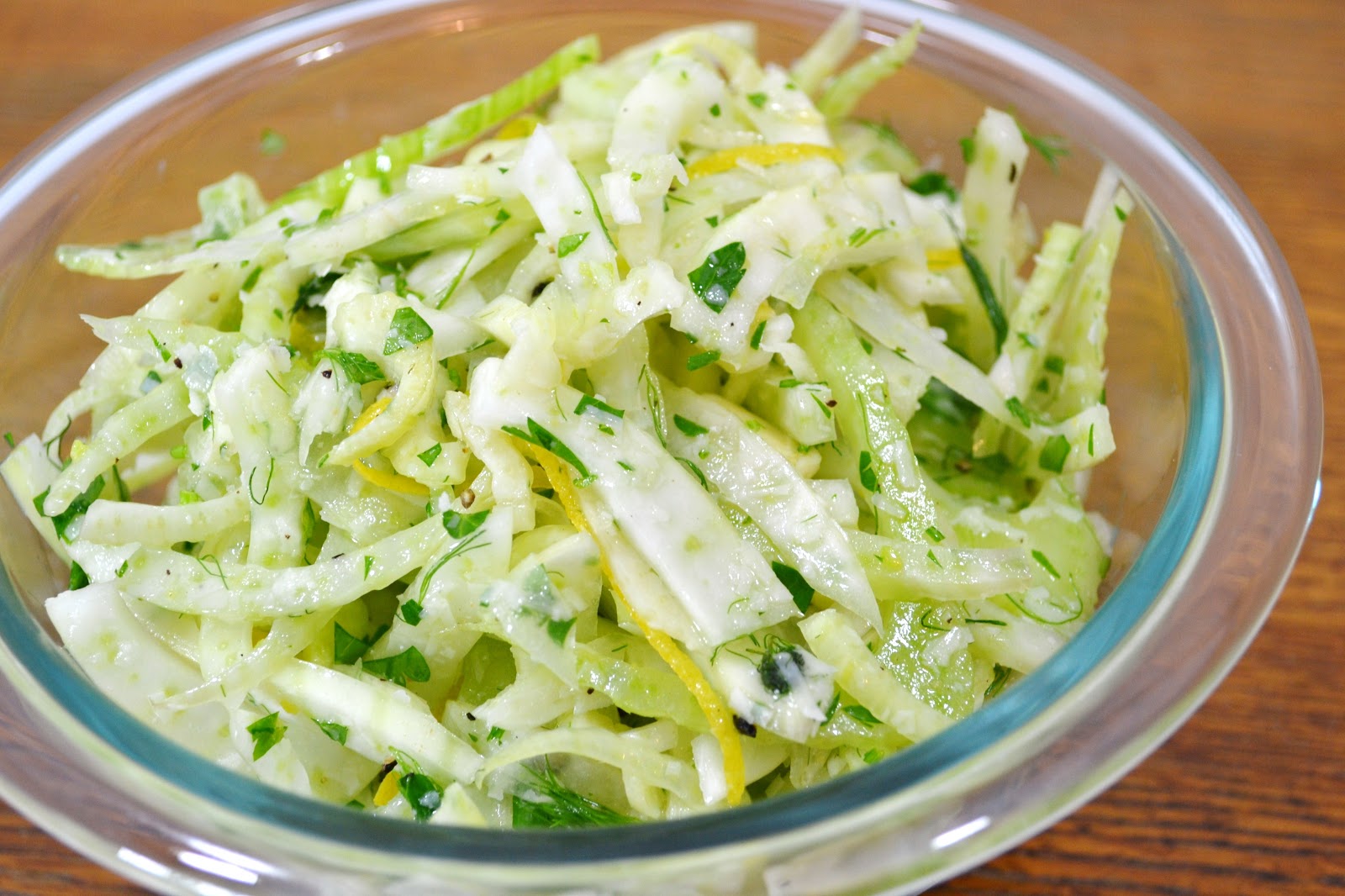
Fennel Slaw


Most nights for dinner I try to incorprate a little salad into my meal to balance out the fat and starch.  Unless there is something green, crunchy, or raw to accompany whatever else I may be eating, I tend to feel weighed down and incomplete. Usually a simple bowl of lettuces (arugula, romaine, mesculen, baby spinach) with a basic vinagrette is all I need to round out the meal, but sometimes I want something a little more exciting....

In the colder months, this shaved brussels sprout and kale salad was my go to when I needed something green and crunchy, but in the warmer months, when there is a greater variety of fruits and vegetables, my salad options become alot more interesting.  I may shave some asparagus with a vegetable peeler and toss with a little lemon juice and olive oil or thinly slice cucumbers and give them a quick marinade in vinegar and top with fresh chopped dill.  When vegetables are in season, there is little you have to do to make them taste really great.

Fennel is one of those vegetables that people either love or hate; being reminiscent of licorice, which can be offputting to some.  Personally I love the delicate flavor and the fact that it pairs well with a variety of foods.  I'm not really sure when fennel is in season in New York.. I usually see it at the farmers market in late summer but for some reason I feel like it's one of those vegetables that I can eat year round. I roast it up all winter long and serve it raw, either juiced or tossed in a salad all throughout the summer months.

Now that it's getting warmer again, I decided to make a simple fennel salad to accompany these quinoa patties.  Thinly sliced fennel is tossed with a little lemon juice and olive oil, then mixed with some fresh grated parmesan and chopped flatleaf parsley. It's fresh and crunchy and the tanginess of the lemon plays off the saltiness of the grated parmesan.  It's one of those salads that comes across as being super fancy but takes less than fifteen minutes to throw togther.

Fennel Slaw (serves 2-4)
Slightly adapted from Sprouted Kitchen

1 large bulb fennel, very thinly sliced
2 T. chopped fennel fronds
1/12 T. fresh lemon juice
1 lemon, zested
1 1/2 T. extra virgin olive oil
2 T. chopped flatleaf parsley
1/4 c. finely grated parmesan cheese
sea salt and fresh cracked pepper, to taste

Using a mandoline or knife, slice the fennel bulbs horiziontally as thinly as possible. Remove any large core parts then add the slices to a mixing bowl with the fronds.
Add the olive oil, lemon juice and zest to the bowl and toss with your hands. Let the fennel sit for 10 minutes to soften.  Before serving, add the parsley, parmesan, a couple pinches of salt and a generous grind of black pepper.  Toss everything together and serve immediately.